BEHIND THE DESIGN - INKHAUS BERLIN TATTOO STUDIO
Behind the Design – Designing a Gallery-Inspired Tattoo Studio
Inkhaus Berlin was developed as a concept portfolio project and a deliberate departure from the types of briefs I usually work on. I’ve always believed that as designers, we shouldn’t limit ourselves to the work we’re already known for. When you’re constantly operating in the same lane, it’s easy for your thinking to become predictable. Creating your own brief, on the other hand, forces you to challenge that routine. It gives you the freedom to explore ideas you might not normally encounter in client work, and it pushes you to think beyond the boundaries of your usual design world.
This project was an opportunity to flex those creative muscles and experiment with a different narrative. It also allowed me to go through the process of writing a design brief entirely from scratch. Instead of responding to a client’s instructions, I had to imagine what that client might want, what their values would be, and what kind of environment they were trying to create. In doing that, I was able to step inside the mindset of the client as much as the designer, which ultimately made the project far more considered.
When working on the concept direction for Inkhaus Berlin, the intention was to challenge the stereotype of what a tattoo studio looks and feels like. When most people imagine a tattoo shop, the imagery tends to be quite predictable: motorbikes, neon signage, dark interiors and walls covered in traditional flash sheets. While there is history and culture within that aesthetic, I wanted Inkhaus to tell a different story.
The idea was to design a space that felt just as much like a gallery, event venue and creative community hub as it did a tattoo studio. The project draws heavily from the spirit of Berlin itself, a city where contrast exists everywhere you look. It’s a place where clarity and chaos collide, where brutalist architecture sits alongside underground clubs and contemporary art spaces. Berlin carries an attitude of grit, individuality and unapologetic expression, and that energy became the backbone of the design.
While the visual concept was important, the space also had to function as a working studio. Tattooing is a highly precise and hygienic practice, so practicality couldn’t be sacrificed for aesthetics. The challenge was to find a balance between creating an environment that felt expressive and atmospheric while still maintaining the cleanliness and efficiency required for the artists to work comfortably.
The material language of the space was inspired directly by the process of tattooing itself. I began by deconstructing the act of tattooing and thinking about the relationship between skin and ink. Skin acts as the canvas, while the tattoo becomes the embellishment layered on top, the two eventually becoming one unified artistic expression.
Translating that idea into architecture led to a clear approach. The “skin” of the building became the base layer of the design. Rather than covering everything up with finished surfaces, the shell of the building is stripped back and exposed in its rawest form. Concrete, brick and plaster remain visible, celebrating the structure rather than hiding it. This approach not only gives the space an honest and authentic quality, but it also references the industrial character often found in Berlin lofts and underground club spaces.
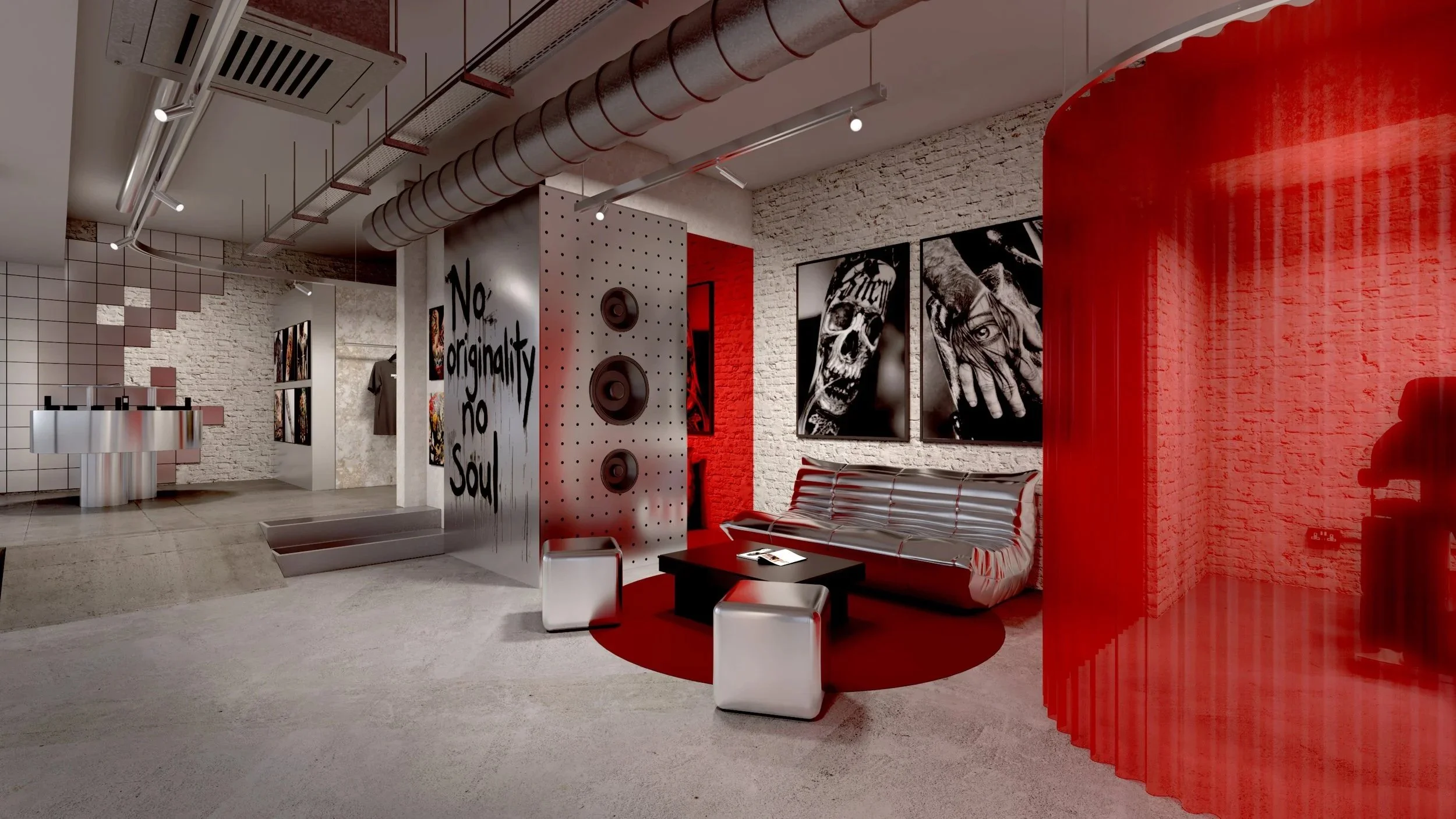
Once the raw shell is established, the secondary layers become the “ink” - the expressive materials that sit on top of the architecture. These materials introduce contrast, texture and symbolism within the space. Perforated metal panels and red mirror elements represent the tattoo needle piercing the skin and the moment ink rises to the surface. It’s a subtle nod to the process without becoming literal.
Fractured metal tiles wrap sections of the walls, creating a fragmented, evolving surface. This element reflects the idea that people with tattoos are often in a constant state of progression, collecting pieces, adding to their story, and never truly being “finished”. Just like the fractured surfaces, the narrative of someone’s tattoos continues to evolve over time.
Flexibility was another key consideration. Inkhaus needed to function not just as a studio, but also as a gallery and event space. To allow the layout to shift depending on the occasion, red PVC curtains are mounted on ceiling tracks and used to separate the tattoo studios from the reception, lounge and retail areas. These curtains are practical, but they also create a striking visual identity throughout the space. As visitors move through the environment, they occasionally catch blurred glimpses of artists working behind the translucent red surfaces, creating a sense of intrigue and atmosphere.
The lounge area sits at the centre of the space and acts as a social hub. Metallic fabric sofas and cube seating are arranged on top of a deep red rug, creating a setting that feels both relaxed and immersive. This area intentionally blends the three identities the space represents, studio, gallery and cultural venue.
Embedded into one of the perforated metal walls are large speaker stacks, referencing Berlin’s world-famous club culture. Opposite this sits a backdrop of large-scale black and white photography celebrating tattoo artistry and the people behind it. A bold custom artwork is painted directly onto the metal cladding in the lounge, reading the words “No originality, no soul.”
This phrase captures the attitude of the space. Inkhaus is built on the idea that repetition and imitation have no place here. The message is intentionally loud, raw and unapologetic, making it clear what kind of environment you’ve stepped into the moment you walk through the door. The aim is for visitors to feel immersed in the Inkhaus community and to understand that they aren’t simply purchasing a tattoo, they’re commissioning a piece of art.
To the left of the main lounge area, the gallery continues into a retail space. Rather than feeling like a traditional shop, the displays are curated more like an exhibition. A grid of artists’ work wraps around the walls, while a large metal display table showcases books, prints and aftercare products. The intention was to blur the line between commercial and cultural, reinforcing the idea that the work created here holds artistic value beyond the tattoo chair.
Although Inkhaus Berlin was a personal concept project, it became an important part of my design development. It allowed me to take full ownership of the process, from writing the brief and defining the narrative, to constantly critiquing and refining the work as it evolved. More than anything, it allowed me to build a portfolio piece that represents the kind of thinking and storytelling I want to bring to future projects and clients.
FULL PROJECT - INKHAUS BERLIN TATTOO STUDIO DESIGN